
The Professional Foundation for Accurate Pool Leak Inspections
If you want to learn pool leak detection the right way, you need more than tools.
You need structure.
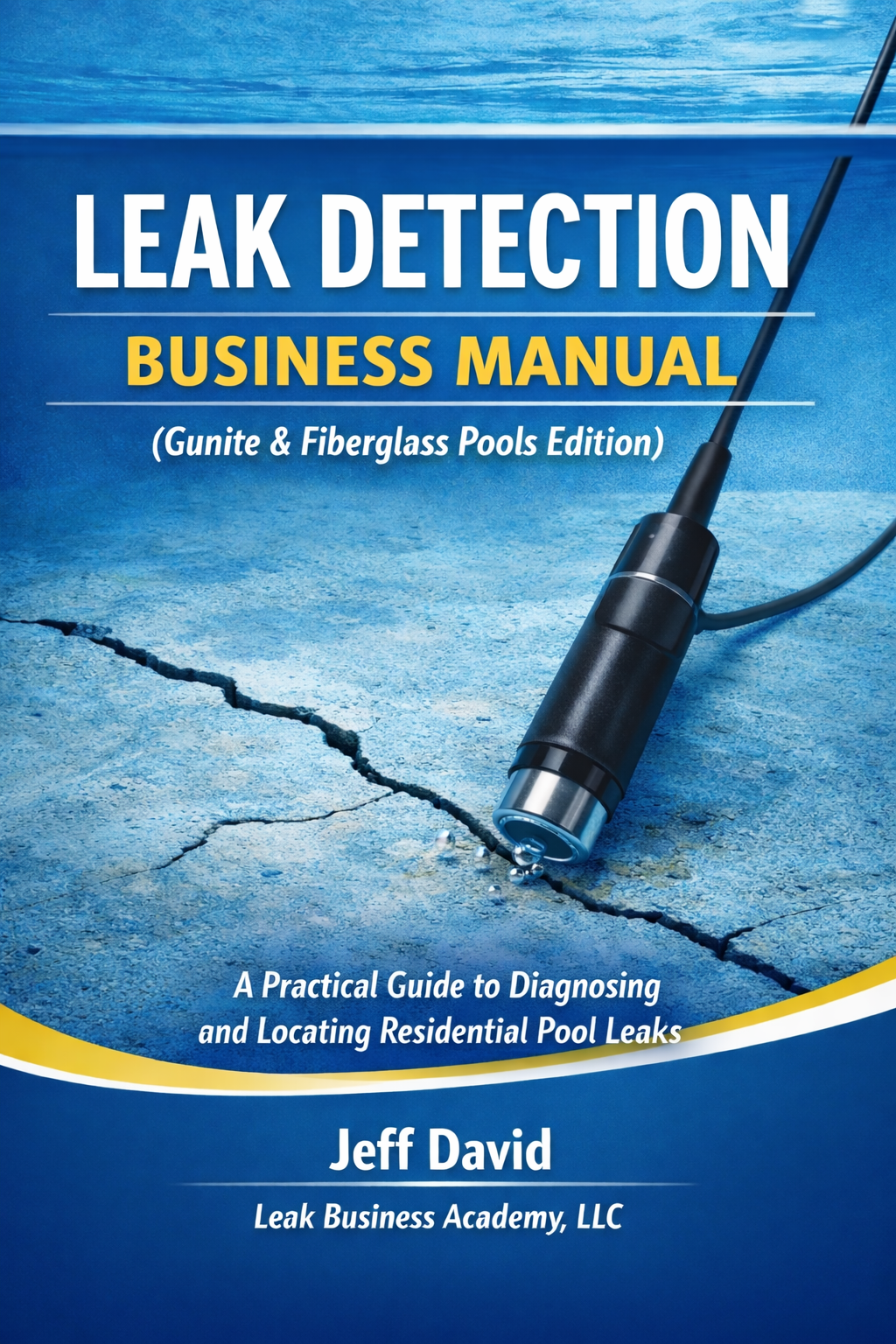
The Residential Pool Leak Detection Manual is a field-tested training guide built to teach professional pool leak inspection workflow, disciplined decision-making, and clearly defined scope boundaries.
This is not a shortcut guide.
This is the foundation professionals use to build a real leak detection business.
Why Most Pool Leak Detection Training Fails
Many technicians enter the trade by:
Buying a hydrophone
Watching random YouTube videos
Learning through expensive mistakes
The problem isn’t effort.
The problem is lack of structure.
Without a defined pool leak inspection workflow, technicians often:
Skip critical inspection steps
Misdiagnose underground pipe breaks
Over-recommend demolition
Damage equipment during testing
Create liability exposure
Lose long-term credibility
Leak detection is not a tool trade.
It is a judgment trade.
Structure protects judgment.
What the Residential Pool Leak Detection Manual Teaches
The manual organizes leak detection into a controlled professional framework.
1. Complete Pool Leak Inspection Workflow
You learn the exact order of operations used in professional inspections, including:
Structured client interview
Initial visual inspection standards
Equipment pad evaluation
Systematic underwater inspection sequence
Evidence documentation protocols
Controlled reporting and recommendation standards
Sequence prevents guesswork.
Guesswork creates liability.
2. The H.U.N.T.E.R. Detection System™
The H.U.N.T.E.R. system teaches technicians to move through inspections methodically:
H – Hear the Client
U – Understand the Pool System
N – Narrow Variables
T – Test Methodically
E – Evaluate Evidence
R – Report & Recommend
This structured approach:
Reduces premature conclusions
Prevents false positives
Builds pricing confidence
Protects professional credibility
Reinforces evidence-based decision making
It was built from thousands of real leak inspections — not theory.
3. Risk & Scope Boundaries (What Most Programs Ignore)
One of the most critical sections of the manual covers:
What a leak detector should inspect
What a leak detector should NOT touch
Detection vs repair boundaries
When to escalate to licensed contractors
Documentation standards that reduce liability
Many technicians damage their business early by crossing scope lines.
Professionals cannot afford that mistake.
4. The First 30–50 Jobs Reality
Most training programs create false confidence.
This manual prepares you for reality:
“No leak found” outcomes
Pressure testing misinterpretation
Tool misuse risks
Customer emotional reactions
Pricing insecurity
High-stress job-site situations
You learn what professional competence actually looks like in the first year.
5. Documentation & Professional Reporting Systems
Strong documentation protects:
Your reputation
Your business
Your long-term referral relationships
The manual outlines real-world reporting standards used by established leak detection businesses.
Professional inspection without documentation is incomplete.
Manual vs Full Digital Course: What’s the Difference?
The Residential Pool Leak Detection Manual teaches foundational inspection structure and judgment discipline.
The Full Digital Course expands into:
Advanced dive demonstrations
Pressure testing techniques
Underground pipe break locating
Escalation decision models
Business survivability principles
Pricing discipline
Customer psychology frameworks
The manual builds your base layer.
The digital course deepens execution.
Together, they form a complete professional system.
Who This Manual Is Designed For
This material is built for:
Pool service professionals adding leak detection
Contractors expanding into inspection services
Entrepreneurs starting a pool leak detection business
Technicians seeking structured professional training
It is not for hobbyists or shortcut seekers.
This is professional-level material.
Why This Manual Was Written
After years in the field, one pattern became clear:
Most failures in leak detection come from poor decision-making — not lack of effort.
The Residential Pool Leak Detection Manual was written to:
Organize the trade
Prevent early-career mistakes
Teach disciplined workflow
Protect technicians from avoidable risk
Build confidence grounded in structure
It gives you stability while your judgment matures.
What Happens Without Structure?
Without a defined inspection system, beginners often:
Chase sounds instead of confirming evidence
Recommend excavation too early
Misinterpret pressure changes
Miss structural indicators
Lose pricing confidence
The result?
Stress.
Refunds.
Doubt.
Structure prevents that.
Build Your Leak Detection Career on a Real Foundation
Pool leak detection is not about owning tools.
It is about making correct decisions under uncertainty.
If you are serious about:
Learning professional pool leak inspection
Protecting yourself from avoidable liability
Building long-term credibility
Entering the trade responsibly
Start with the foundation.
👉 Learn more at www.LeakBusinessAcademy.com
Frequently Asked Questions
What is the Residential Pool Leak Detection Manual?
It is a structured training guide that teaches professional pool leak inspection workflow, documentation standards, and risk boundaries for technicians and business owners.
Is pool leak detection a profitable business?
It can be a specialized and viable service business depending on market demand, licensing, pricing discipline, and operational structure. Success depends on training, judgment, and professionalism.
What equipment is needed to start?
Basic equipment includes dye testing kits, pneumatic test plugs, pressure testing manifold, hydrophone, air source, dive gear, and documentation tools.
Do I need a license to perform leak detection?
Licensing requirements vary by state and municipality. Detection and repair services may require contractor or plumbing licenses depending on scope. Always verify local regulations.
What is the H.U.N.T.E.R. Detection System?
It is a structured workflow that guides technicians through client intake, system analysis, controlled testing, evidence evaluation, and professional reporting.