
Is My Pool Leaking or Just Evaporation? How to Tell the Difference (Free Calculator)
The question is not whether your pool is losing water.
The question is whether it’s losing more than it should.
A half-inch drop over a few days might be completely normal.
Or it might be the first warning sign of a leak quietly damaging your pool, deck, and surrounding soil.
Most homeowners guess.
This guide will show you how to stop guessing.
How Much Water Should a Pool Lose Per Day?
Under normal conditions, most residential pools lose:
1/8 to 1/4 inch per day due to evaporation.
But that range can change dramatically based on:
Air temperature
Water temperature
Wind speed
Humidity (dew point)
Sun exposure
Water features (fountains, waterfalls, bubblers)
Whether a cover is used
On hot, dry, windy days, evaporation can exceed 1/2 inch per day.
In humid or shaded environments, it may be far lower.
That’s why generic rules of thumb fail.
Evaporation is weather-driven and location-specific. The only reliable way to know what your pool should be losing is to calculate it using real atmospheric data.
Signs the Water Loss Is Probably Evaporation
Water loss is likely evaporation if:
Loss remains consistent day to day
It increases during hot, windy conditions
It slows during cooler or rainy periods
There are no wet spots around the pool
The pool does not stop losing water at a specific level
Evaporation happens evenly across the surface. It does not create structural symptoms.
Signs Your Pool May Have a Leak
Water loss may indicate a leak if:
The pool drops more than 1/4 inch per day under moderate conditions
The loss continues regardless of weather changes
The water level stops dropping at a specific height
You notice air in the pump system
There are soft or eroding areas near the deck
You must add water more than once per week
Leaks rarely fix themselves. They tend to grow.
Water under pressure moves through plumbing joints, cracks, conduit lines, and soil. Over time, it can erode structural support beneath decks and surrounding surfaces.
The Two Most Expensive Water Loss Mistakes
Mistake #1: Calling for Leak Detection When It’s Normal Evaporation
Many pool owners panic during hot weather.
They schedule leak detection only to discover the water loss matches normal evaporation for current conditions.
That costs time and money unnecessarily.
Mistake #2: Assuming It’s Evaporation When It’s Actually a Leak
This mistake is worse.
A small plumbing leak can saturate soil, wash away compacted fill, and destabilize surrounding structures. The longer it goes undiagnosed, the more expensive the repair becomes.
The solution to both mistakes is the same:
Establish your evaporation baseline first.
Step 1: Calculate Your Evaporation Baseline (Free Tool)
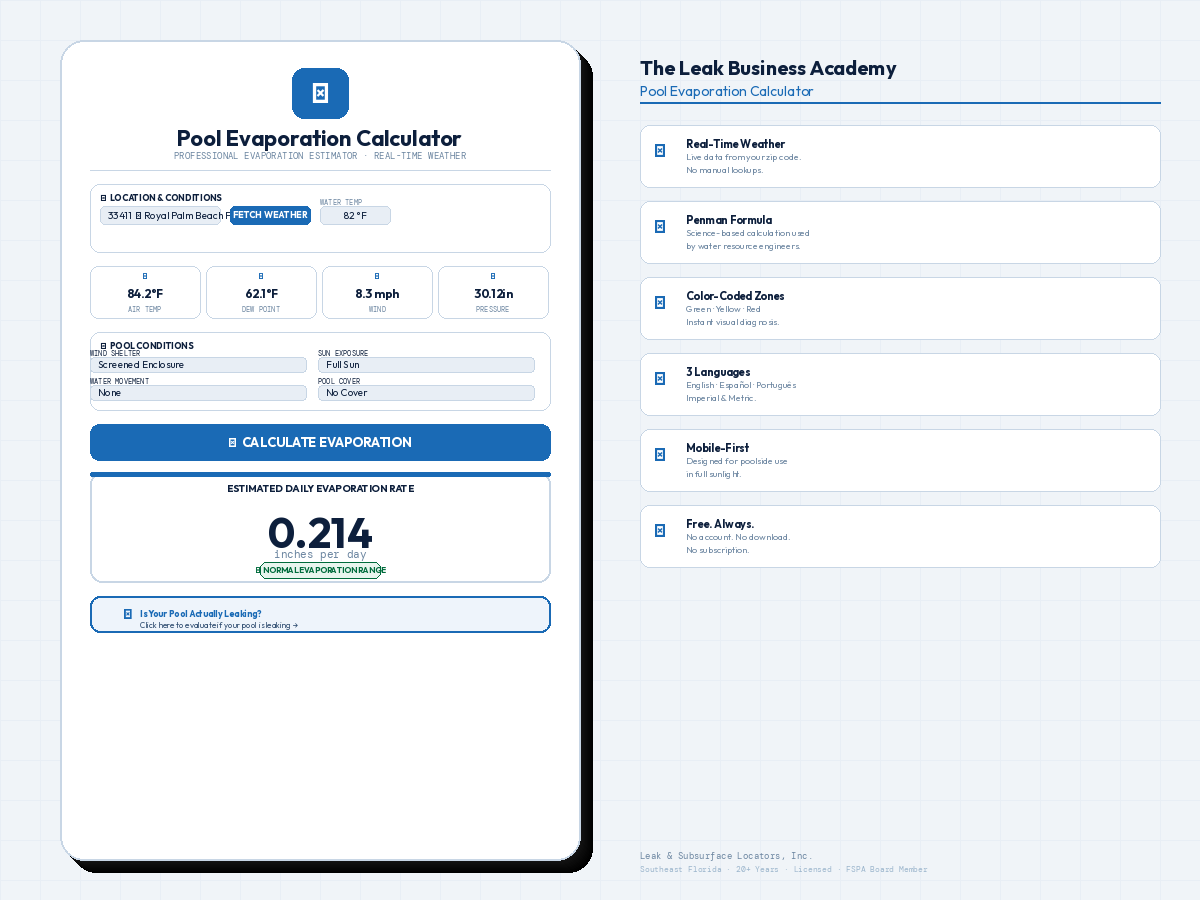
We built a free Pool Evaporation Calculator that uses live weather data and an adaptation of the Penman evaporation formula — the same scientific foundation used in hydrology and agricultural water management.
It automatically pulls:
Dew point
Air temperature
Wind speed
Barometric pressure
You enter:
Water temperature
Sun exposure
Wind shelter
Water movement
Pool cover usage
The calculator then provides:
Daily evaporation rate (inches or centimeters)
Weekly and monthly projections
A color-coded assessment (Normal, Elevated, Very High)
It works on any device and requires no sign-up.
This gives you a scientifically grounded number for what your pool should be losing today.
Step 2: Compare Measured Loss to Evaporation
Once you know your baseline, measure your actual water loss over several days.
If your measured loss:
Matches the calculated evaporation rate → likely normal
Slightly exceeds it → monitor closely
Significantly exceeds it → strong indication of a leak
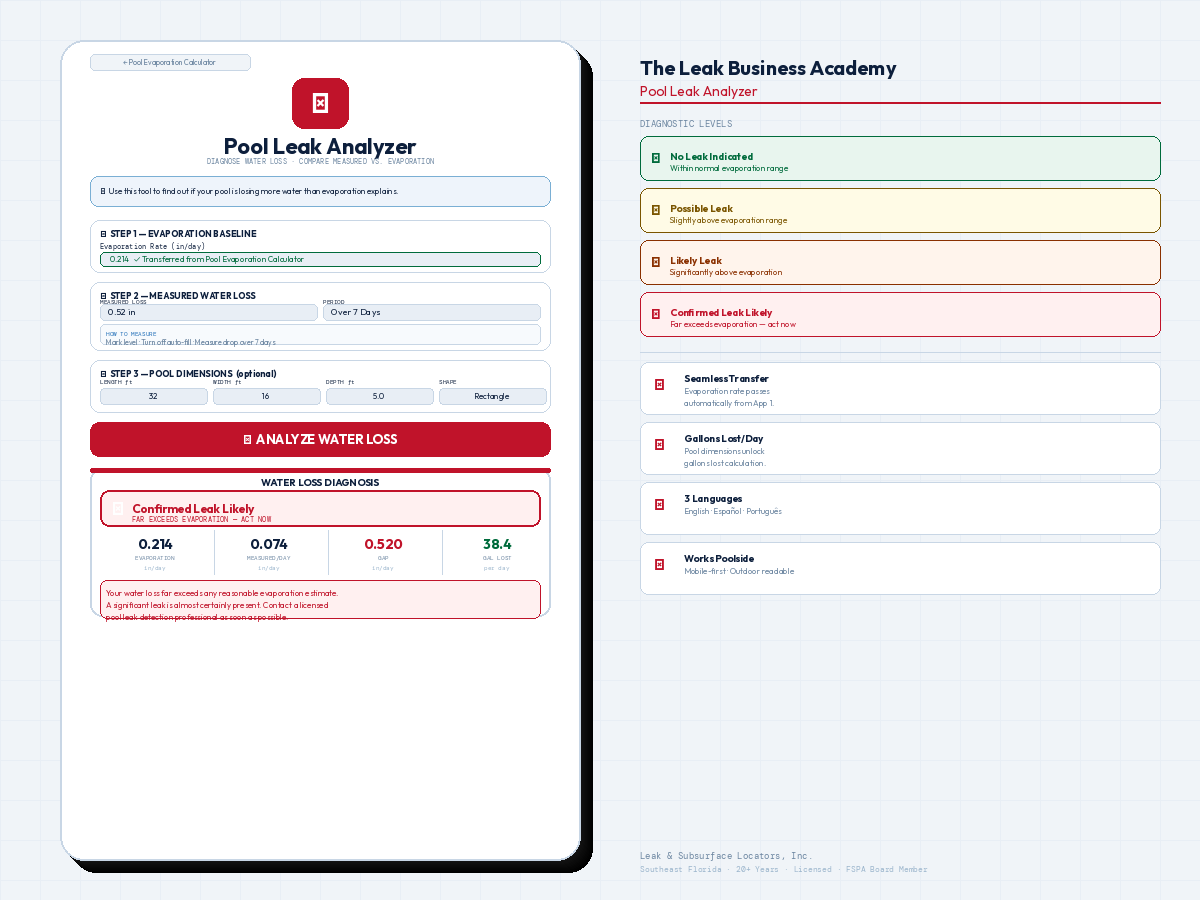
For deeper analysis, the Pool Leak Analyzer compares measured loss against evaporation and estimates potential gallons lost per day. It also adjusts for rainfall — a factor most tools ignore.
Together, these tools remove guesswork.
When to Call a Leak Detection Professional
You should consider professional evaluation if:
Water loss exceeds calculated evaporation consistently
The pool drops rapidly (over 1/2 inch per day)
Loss continues regardless of weather
You observe structural symptoms
The water stops at a repeatable level
Data first. Then action.
Why This Matters
Pool water loss is one of the most misdiagnosed issues in residential pool ownership.
Without a real evaporation baseline, you are operating blind.
You either overreact — or underreact.
Both cost money.
Establishing the correct evaporation rate allows you to make calm, informed decisions grounded in physics, not assumptions.
Frequently Asked Questions
How much water loss is normal for a pool?
Most residential pools lose between 1/8 and 1/4 inch per day due to normal evaporation. However, weather conditions such as heat, wind, and humidity can increase that amount significantly. A weather-based evaporation calculation provides a more accurate baseline.
How do I know if my pool leak is serious?
Compare your measured water loss to a calculated evaporation rate based on current weather conditions. If your pool consistently loses more water than evaporation explains, a leak may be present.
What is considered excessive pool water loss?
Water loss exceeding 1/4 inch per day under moderate weather conditions may indicate a leak. Loss greater than 1/2 inch per day should be investigated promptly.
Can rain hide a pool leak?
Yes. Rain adds water to your pool and can temporarily mask actual water loss. This is why rainfall-adjusted comparisons are important when diagnosing leaks.
Is the bucket test reliable?
The bucket test can provide a rough comparison, but it does not account for wind, humidity, dew point, or other atmospheric variables. A weather-based evaporation calculation is more precise.
Final Thought
Evaporation is predictable.
Leaks are not.
If you understand the difference, you protect your pool, your property, and your finances.
Start with the evaporation baseline.
Then compare the data.
Then decide.